DevMode
Vol. 30 No. 1&2 , 2026
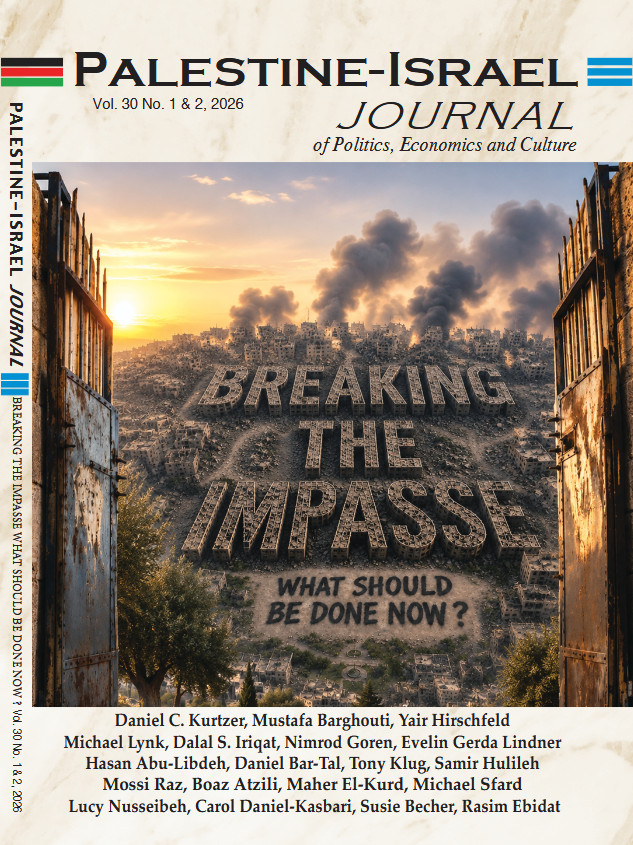
Breaking the Impasse, What Should Be Done Now?
Editorial

After over 1,000 days of the deadly Gaza War, this is the big question that confronts all who are concerned about the future of both the Palestinians and the Israelis. Although a ceasefire was declared in October 2025 and all the hostages, living and dead, were returned in exchange for some 2,000 of the approximately 10,000 Palestinian prisoners held by Israel, the fighting has continued, and close to 1,300 Palestinians have been killed since the ceasefire. Radical settlers and the “Hilltop Youth” settlers militia, frequently backed and at times in conjunction with IDF soldiers, especially the Netzah Yehuda unit, have carried out pogroms against Palestinians in the West Bank. Meanwhile, Bezalel Smotrich, minister in the Ministry of Defense, continues to promote his 2017 annexationist “Decisive Plan” through further settlement expansion. A second Israel-U.S. attack on Iran also took place, and there is continued fighting between Israel and Hezbollah on the
    read more ...


This issue was sponsored by
Friedrich Ebert Stiftung
Table of Contents
    Editorial
  1. Where Do We Go From Here? ( )

    By Ziad AbuZayyad and Hillel Schenker Vol. 30 No. 1&2 2026
  2. Focus
  3. The Language of Crime ( )
    Hebrew, once the language in which a moral universe of humanism was articulated, became the language in which the orders to destroy the Gaza Strip were given and is now the language of vengeful and merciless destruction.
    By Michael Sfard Vol. 30 No. 1&2 2026
  4. Ending Control, Not Managing Conflict: Palestinian Liberation and the Future ofIsrael-Palestine ( )
    To truly resolve the conflict, there is a need for a new political vision in which peace is not defined by the absence of war but by the end of domination, the recognition of Palestinian freedom, and a political order in which one people doesn’t govern another.
    By Carol Daniel-Kasbari Vol. 30 No. 1&2 2026
  5. Making Peace is Not Rocket Science ( )
    It is not hard to define what needs to be done to achieve peace between Israel and Palestine, yet a lack of leadership as well as psychological concerns are among the factors keeping the obvious solution – two states – from happening.
    By Daniel Kurtzer Vol. 30 No. 1&2 2026
  6. Guidelines for the Israeli-Palestinian Peace Negotiations ( )
    If a diplomatic initiative is to succeed, it will have to meet the basic conditions of strategic preparation, disciplined negotiation, credible implementation, and the cultivation of trust.
    By Yair Hirschfeld and Raphael Cohen-Almagor Vol. 30 No. 1&2 2026
  7. From the Status Quo to Economic Recovery and Statehood ( )
    To achieve a viable state, economic recovery, institutional renewal, territorial reunification, and the restoration of Palestinian sovereignty must be pursued as interconnected objectives within a clearly defined and time bound process.
    By Maher El-Kurd Vol. 30 No. 1&2 2026
  8. It’s Still the Occupation, Stupid! ( )
    While many actors and a range of circumstances have played detrimental roles over the years, the bottom line is that the conflict will continue as long as Israel continues to occupy the Palestinians’ land and deny them independence.
    By Tony Klug Vol. 30 No. 1&2 2026
  9. Departing From Hatred and Violence to a Space of Hope and Open Horizons of Peace ( )
    There will be no resolution without acknowledgment that the conflict is political and will not be resolved through violence but rather by ending the Israeli occupation and enabling the Palestinians to exercise their right to self-determination in an independent state.
    By Ziad AbuZayyad Vol. 30 No. 1&2 2026
  10. Linking Legal Struggle with the Political Struggle to Get on the Right Side of History When It Comes to Palestine ( )
    Human rights defenders must address the shortcomings of the international political system and its lack of accountability while continuing to pursue the legal victories that are encouraging the growing global social movement in support of Palestine.
    By Michael Lynk Vol. 30 No. 1&2 2026
  11. Immediate Resolution of the Conflict Is the Only Answer to ‘What’s Next?’ ( )
    Visions, roadmaps, and processes are not enough of an answer for Palestinians who have been denied a life of dignity and freedom for almost 80 years and have seen how violence awakens the international community from its conflict management stupor.
    By Susie Becher Vol. 30 No. 1&2 2026
  12. A Roadmap for Hope: What Must Be Done Now Two States or Endless Hatred: The Choice Before Us ( )
    Any serious strategy for the future must recognize that both sides are here to stay and that the only way to end the conflict is through a political agreement that leads to a viable Palestinian state living in peace alongside the State of Israel
    By Hasan Abu-Libdeh Vol. 30 No. 1&2 2026
  13. The Fog of the Future: Scenarios for the U.S. Role in the Israel-Palestine Conflict ( )
    Assessing the various policy outcomes that may emerge four years from now as a result of different combinations of leadership in Washington and Jerusalem may help us take steps that advance the positive ones and forestall the negative ones.
    By Boaz Atzili Vol. 30 No. 1&2 2026
  14. The Upcoming Israeli Elections Beyond the Power Struggle Between Netanyahu and His Opponents ( )
    The upcoming Israeli elections appear to be a referendum on the results of a war whose repercussions continue to unfold, the limits of Israeli power, and the future of Israel-U.S. relations rather than on a resolution of the conflict with the Palestinians.
    By Rasim Ebidat Vol. 30 No. 1&2 2026
  15. How Much Change Will a ‘Change Government’ Bring? ( )
    A government of change in Israel will not include a two-state solution on its agenda, but it may be ready for some compromise on the Palestinian issue in order to improve relations with the U.S., Arab states, Europe, and the rest of the world.
    By Mossi Raz Vol. 30 No. 1&2 2026
  16. On the Eve of The Israeli Elections: Israel Will Not Change from the Inside ( )
    With even the majority of Israeli society sliding toward fascist ideas, the only way forward is to make the cost of continued occupation too high for it to bear through Palestinian steadfastness and international sanctions.
    By Mustafa Barghouti Vol. 30 No. 1&2 2026
  17. The Need for Principled Political Engagement of Shifting from Conflict Management to Resolvement ( )
    Incremental political approaches and repeated cycles of violence have failed, leaving us with a strategic imperative to shift from conflict management to conflict termination with the support of the leaders and publics on both sides and of the international community.
    By Dalal Iriqat Vol. 30 No. 1&2 2026
  18. How Can the EU Put Its Staunch Support for an Israeli-Palestinian Two-State Solution into Practice? ( )
    There are many steps the EU can take in the spheres of political, diplomatic, and civil society activism to support Israeli and Palestinian peacebuilders, including prioritizing a realistic action plan to achieve a predefined final-status agreement.
    By Nimrod Goren Vol. 30 No. 1&2 2026
  19. Thirty Years After Dayton: What Bosnia’s Peace Can and Cannot Lend to Israel-Palestine ( )
    The 30th anniversary of the Dayton agreement that brought peace to Bosnia and Herzegovina is being marked by many challenges, yet it has many valuable lessons to teach Israelis and Palestinians about what should and should not be done.
    By Klara Vlahčević Lisinski Vol. 30 No. 1&2 2026
  20. Censorship and Self Censorship in Israel ( )
    Censorship and self-censorship have existed since the State of Israel was founded, but recent years have seen more restrictions on freedom of the press and the use of indirect mechanisms such as political intimidation to expand self-censorship in various spheres.
    By Daniel Bar-Tal Vol. 30 No. 1&2 2026
  21. Middle East Wars: The Future of Military Action and the Fate of Agreements ( )
    The wars fought across the region over the past three years have produced fundamental shifts that will lead to regional change, but the direction that change will take will not be independent of the outcome of the Israeli, Palestinian, and U.S. elections in the fall.
    By Samir HuleiIeh Vol. 30 No. 1&2 2026
  22. When Humanity Fails Its Own Dignity: Humiliation, Trauma, and the Mandate to Create a World of Dignity ( )
    Once both sides understand that dehumanization is a distorted acknowledgment of the other’s humanity rather than an erasure of it, they will be open to understanding the cycles of violence we are witnessing and move toward ending, healing, and preventing them.
    By Evelin Gerda Lindner Vol. 30 No. 1&2 2026
  23. War Is No Solution ( )
    Although many leaders argue that there is no alternative to war and others are exploiting war for profit, reality ultimately shows that security depends not on military actions but on providing safety and dignity to human beings.
    By Lucy Nusseibeh Vol. 30 No. 1&2 2026
  24. Countering Injustice in Area C Through Protective Presence ( )
    In the name of Jewish values, the Zionist vision, and international law, thousands of Israelis are participating in the protective presence project that aims to protect Palestinians in Area C from Jewish terrorist attacks and abuse by IDF soldiers.
    By Rabbi Ruthi Baidatz and Rabbi Dani Danieli Vol. 30 No. 1&2 2026
  25. Book Review
  26. The Future is Peace: A Shared Journey Across the Holy Land ( )
    The Future is Peace: A Shared Journey Across the Holy Land: Maoz Inon & Aziz Abu Sarah, Crown, 2026, 240 pgs.
    By Lucy Nusseibeh and Galit Hasan-Rokem Vol. 30 No. 1&2 2026
  27. Sabri Jiryis, The Foundations of Zionism ( )
    Sabri Jiryis The Foundations of Zionism. Translated and Edited by Fida Jiryis. Oxford: Liberated Texts / Ebb Books, 2025. 614 pp.
    By Yehuda Lukacs Vol. 30 No. 1&2 2026
  28. Nubar Hovespian, Edward Said: The Politics of an Oppositional Intellectual ( )
    Nubar Hovespian, Edward Said: The Politics of an Oppositional Intellectual Cairo: American University in Cairo Press, 2025
    By Peter Eisentadt Vol. 30 No. 1&2 2026
  29. Yehuda Lukacs: Op-Ed: Musings on War & Peace in the Middle East and Beyond ( )
    Yehuda Lukacs: Op-Ed: Musings on War & Peace in the Middle East and Beyond. Amazon. 2025, 281 pp.
    By Larry Garber Vol. 30 No. 1&2 2026
  30. Micah L. Sifry: When Doves Try: Israel’s Peace Now Movement 1978-1983 ( )
    Micah L. Sifry: When Doves Try: Israel’s Peace Now Movement 1978-1983 — With An Epilogue For The Post-October 7 World, 2025, 165 pg.
    By Ralph Seliger Vol. 30 No. 1&2 2026
  31. Culture, Literature and the Arts
  32. I Grant You Refuge ( )

    By Hiba Abu Nada Vol. 30 No. 1&2 2026
  33. Not Just Passing ( )

    By Hiba Abu Nada Vol. 30 No. 1&2 2026
  34. It No Longer Matters If Anyone Loves Us ( )

    By Samer Abu Hawwash Vol. 30 No. 1&2 2026
  35. What Will Come ( )

    By Nathan Wasserman Vol. 30 No. 1&2 2026
  36. On the Day of Mary’s Ascension to Heaven ( )

    By Nathan Wasserman Vol. 30 No. 1&2 2026
  37. Documents
  38. Call for EU Action ( )

    Vol. 30 No. 1&2 2026
  39. Human Rights Call ( )

    Vol. 30 No. 1&2 2026
  40. The Paris Call for the Two State Solution ( )

    Vol. 30 No. 1&2 2026